Picture this: you wake up, stroll five minutes to grab your morning coffee, walk your kids to school just around the corner, swing by the grocery store on the way home, and later meet friends at a nearby park—all without getting in a car. Sounds like a dream? Welcome to the 15-minute city, one of the most prominent trends reshaping urban life around the world today.
As more than half the world’s population now calls cities home, urban planners and city leaders are rethinking how we live, work, and navigate our urban environments. The 15-minute city concept isn’t just about convenience—it’s about creating neighborhoods where everything you need is within a short walk or bike ride. And it’s catching on fast, from Paris to Melbourne, reshaping how millions of people experience their daily lives.
What Exactly Is a 15-Minute City?
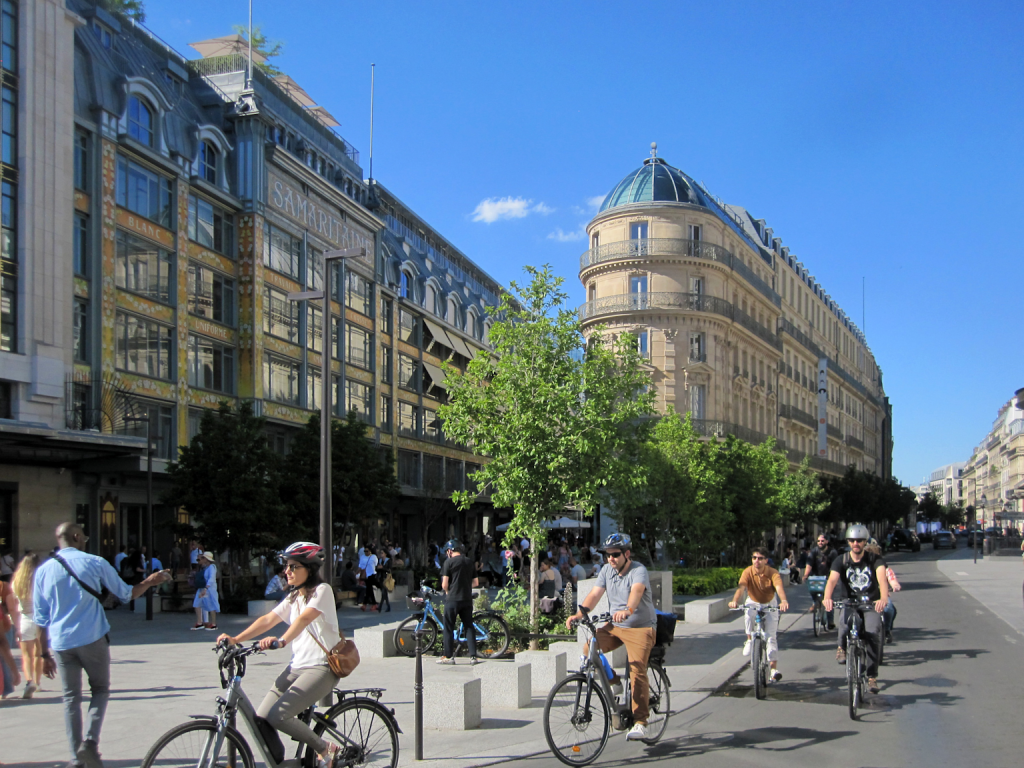
Cyclists and pedestrians enjoy a sunny day in a walkable Paris neighborhood with classic architecture , Source: Wikipedia
The core idea is beautifully simple: design neighborhoods so residents can access their daily essentials—work, shopping, schools, healthcare, parks, and entertainment—within a 15-minute walk or bike ride from home. For walking, this typically means everything within about a kilometer (roughly 0.6 miles) of your front door.
But here’s the thing—it’s not about making an entire city traversable in 15 minutes. Instead, it’s about creating multiple self-sufficient neighborhoods within a larger city, each packed with the amenities people need. Think of it as bringing life back to local communities rather than forcing everyone to commute across town for every little thing.
The concept was popularized by urbanist Carlos Moreno in 2016, who outlined six essential functions every neighborhood should offer within that golden 15-minute radius: living, working, commerce, healthcare, education, and entertainment. His vision rests on four pillars: density (enough people to support local services), proximity (bringing amenities closer), diversity (mixed-use development), and digitalization (using technology to reduce the need for physical travel).
Why Cities Are Going All-In on This Trend
The momentum behind 15-minute cities isn’t happening by accident. Cities worldwide are dealing with some serious challenges, and this approach tackles several at once.
Fighting Climate Change, One Neighborhood at a Time
Transportation is now the world’s biggest polluting sector, and personal vehicles are the main culprit. When you design neighborhoods where people can walk or bike instead of drive, you’re cutting carbon emissions in a big way. Paris, for instance, has made the 15-minute city “the backbone for creating a new urban plan,” with Mayor Anne Hidalgo championing this approach as central to the city’s climate goals.
The numbers tell the story: economist Joe Cortright found that Portland residents drive 20 percent less on average than typical Americans, creating a $1.2 billion “green dividend” that stays in the local economy instead of going to gas stations. That’s money supporting local businesses, creating jobs, and keeping neighborhoods vibrant.
Making Cities More Livable (and Lovable)
Let’s be honest—nobody enjoys sitting in traffic or hunting for parking. The 15-minute city concept acknowledges a basic truth: people prefer shorter trips. When daily necessities are nearby, you’re more likely to walk or bike, which means healthier residents, cleaner air, and streets that feel safer.
Research backs this up in a big way. A 2019 study found a direct link between a city’s walkability and children’s social and economic mobility—kids who grow up in walkable neighborhoods tend to be healthier and earn higher incomes later in life, likely because they’re closer to job opportunities and build better social connections. Another 2023 study discovered that people aged 36 to 45 living in walkable areas are happier, period.
Boosting Local Economies
Here’s something that might surprise you: walkable neighborhoods aren’t just nicer—they’re richer. Across metro areas, walkable urban places command commercial rent premiums 75 percent higher than car-dependent suburban areas. Cities with more walkable neighborhoods also have higher educational attainment and GDP per capita.
Why? When people walk through their neighborhood instead of driving through it, they’re more likely to stop at that local café, browse that independent bookstore, or grab groceries from the corner market. These daily interactions build a thriving local economy and create a genuine sense of community that’s hard to find when everyone’s zooming past in cars.
Cities Leading the Way
Paris: The Poster Child
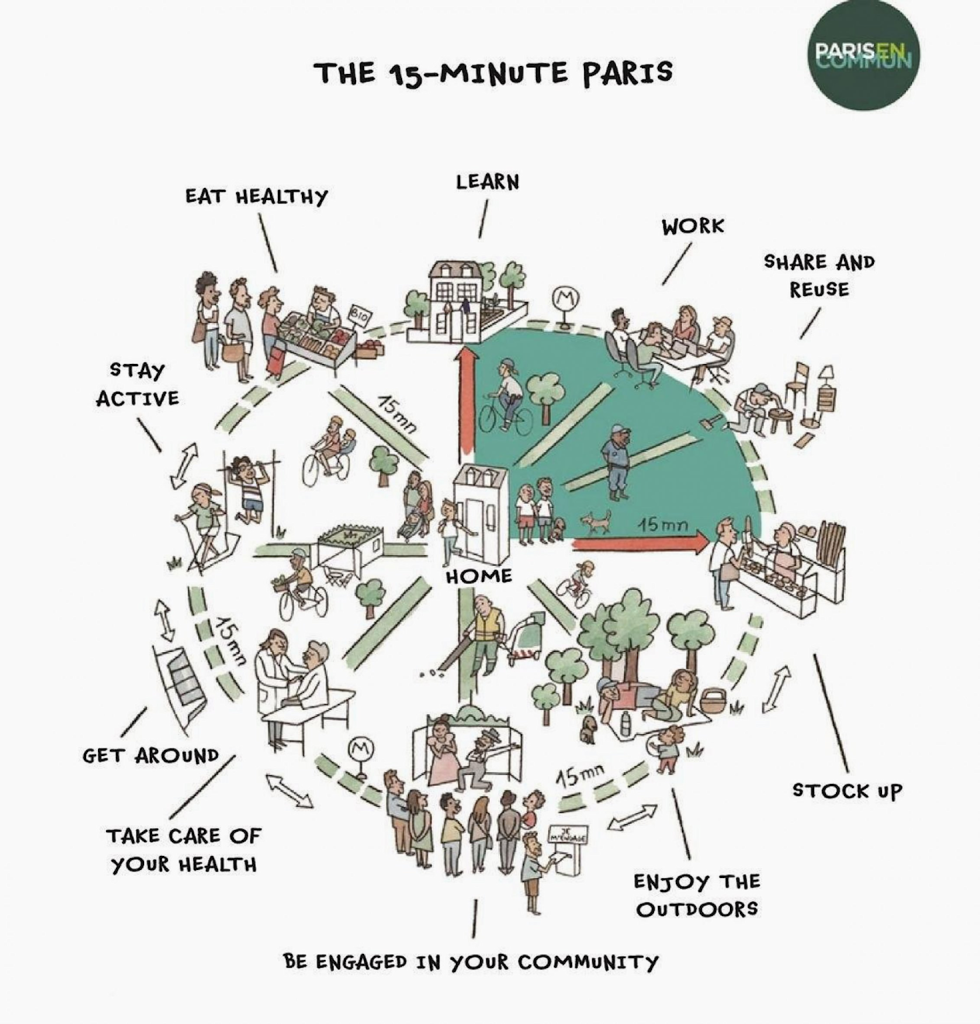
The 15-minute city concept is illustrated through daily activities reachable within 15 minutes from home in Paris. Source : Dezeen
Paris has become the global face of the 15-minute city movement, and it’s not hard to see why. The city already had a head start—an impressive 94 percent of Parisians live within five minutes of a bakery. But Mayor Anne Hidalgo has taken things much further, with 50 fifteen-minute neighborhoods already operational and ambitious plans to expand.
The city’s transformation has been dramatic. Paris now has nearly 1,500 kilometers of cycle paths, and more Parisians bike than drive. In March 2025, Parisians voted to create 5-8 new green and pedestrian streets in each neighborhood, streets that will be “highly ambitious in terms of biodiversity” with at least 50 percent regional plant species. The city is also replacing 60,000 parking spaces with trees as part of its 2024-2030 Climate Plan, aiming to create 300 hectares of new green space by 2030.
Barcelona’s Superblocks Revolution
Barcelona took a different approach with its “Superblocks” (superilles)—groups of nine city blocks where car traffic is heavily restricted. Vehicles are rerouted around these zones, and inside, only local residents and delivery services can enter, at speeds no faster than 10 kilometers per hour. Pedestrians and cyclists rule the roost.
The results? Air and noise pollution have dropped. Accidents have decreased. Public spaces that were once dominated by cars have become community gathering places for markets, events, and play. There’s a palpable sense of social renewal, with residents interacting more and feeling more connected to their neighbors.
Melbourne’s 20-Minute Neighborhoods
Australia’s fastest-growing city is tackling this challenge head-on with its “20-minute neighborhoods” initiative, part of Plan Melbourne 2017-2050. It’s an ambitious undertaking—Melbourne is one of the largest cities by land area in the world, with well-established infrastructure that needs retrofitting rather than building from scratch.
The city’s plan emphasizes safety, accessibility, climate resilience, local economic support, and quality public spaces. It’s proof that even sprawling cities built around cars can transform themselves, though it requires serious commitment and creative solutions.
Singapore’s Vertical Vision
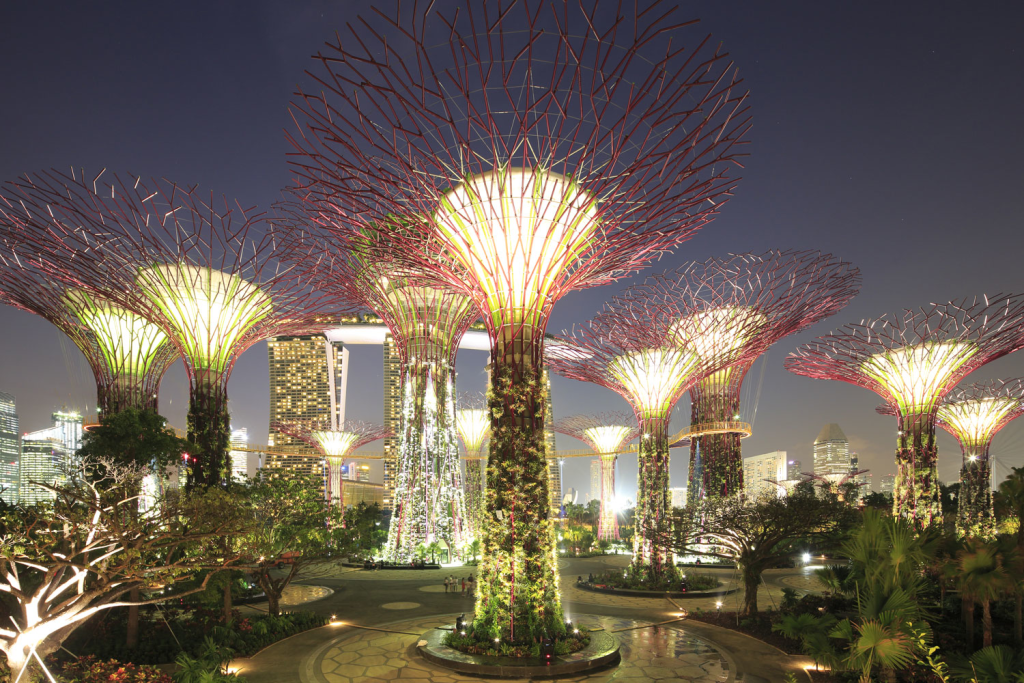
The Supertrees at Singapore’s Gardens by the Bay light up the urban night, blending nature and technology in city life. Source: Greenroofs
While not strictly a 15-minute city, Singapore deserves mention for its innovative “City in a Garden” approach. The city-state requires new developments to replace any green space lost at ground level with greenery elsewhere—often in the sky. This has spawned a breeding ground for truly green buildings, from Marina One’s terraced multilevel garden with 350+ species to the Parkroyal Collection Pickering hotel, where tropical plants drape from sky gardens every four levels.
The iconic Supertree Grove at Gardens by the Bay showcases 18 tree-like vertical gardens ranging from 80 to 160 feet high, covered with over 160,000 varieties of orchids, ferns, and climbing plants. Eleven of these “trees” generate solar power, making this a 24-hour horticultural haven that brings nature into the heart of a dense urban area.
The Green Revolution: Bringing Nature Back to Cities
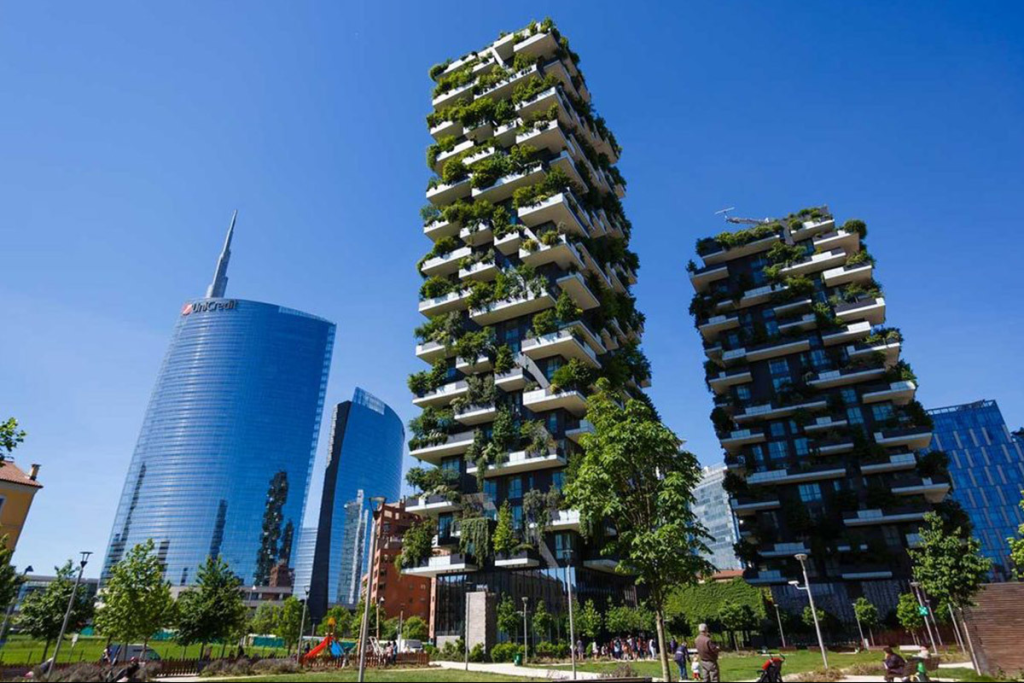
Bosco Verticale in Milan: eco-friendly high-rise buildings with greenery integrated on every balcony, promoting sustainable urban living. Source : Pedestal-Eternoivica
One of the most exciting aspects of modern urban transformation is the explosive growth of urban greening. Cities aren’t just rethinking proximity—they’re fundamentally reimagining their relationship with nature.
Vertical Forests: Buildings That Breathe
Milan’s Bosco Verticale (Vertical Forest) has become one of the most iconic buildings of the last decade. Designed by Stefano Boeri and completed in 2014, this complex features two residential towers of 110 and 76 meters hosting 800 trees, 4,500 shrubs, and 20,000 plants from about 100 different species.
The numbers are staggering: these towers house vegetation equivalent to about five hectares of parkland, but concentrated on just 1,000 square meters—fifty times less space. The 20,000 trees and plants convert approximately 44,000 pounds of carbon each year. They also regulate temperatures in the buildings year-round, shading interiors from summer sun and blocking harsh winter winds, while protecting residents from noise pollution and street-level dust.
This isn’t just an architectural statement—it’s a model being replicated worldwide. The Council on Tall Buildings and Urban Habitat called it the “most beautiful and innovative skyscraper in the world” in 2015. And Boeri’s vision is spreading, with vertical forest projects planned or underway in other cities.
The Science Behind Urban Green Spaces
The benefits of bringing nature into cities go way beyond aesthetics. Green infrastructure—from parks and street trees to green roofs and urban forests—provides measurable improvements to urban life and human health.
A groundbreaking study from Texas A&M University found that city dwellers with more exposure to urban green spaces require fewer mental health services. The research used NatureScore, which calculates the amount and quality of natural elements for any address in the United States, and found a clear correlation: more nature means better mental health.
The mechanisms are well understood. Spending time in green spaces lowers cortisol levels, the hormone associated with stress. Trees improve air quality by removing pollutants, support mental health, and create more livable neighborhoods. Urban forests in the United States generate an estimated $5.4 billion annually in air pollution removal and another $5.4 billion in energy savings.
Green infrastructure also tackles the “urban heat island” effect—a phenomenon where dense urban areas trap heat from human activity, making cities several degrees hotter than the surrounding countryside. By introducing greenery, particularly on roofs, cities can provide shade and cool the air through evapotranspiration, while also removing air pollution, sequestering carbon, and regulating water by trapping stormwater.
According to the Cool Cities Network, the number of cities exposed to extreme temperatures will nearly triple over the next few decades, with more than 970 cities experiencing average summertime highs of 35°C by 2050. Green infrastructure isn’t optional anymore—it’s essential for urban survival.
Rewilding Cities: Letting Nature Lead
Taking urban greening a step further is the concept of urban rewilding—reintroducing native plants and animals, reconnecting green corridors, and letting ecosystems regenerate with minimal human interference. This means allowing meadows and wetlands to grow naturally, reintroducing pollinators and urban wildlife, creating green roofs and living walls, and removing concrete to let soil breathe.
London’s River Thames is seeing the return of seals, seahorses, and even sharks thanks to improved water quality and habitat restoration. Barcelona’s green corridors show how rewilded cities can reconnect people with nature while improving biodiversity. These aren’t just feel-good projects—they’re strategic responses to heat waves intensified by urban heat islands, flash floods from sealed surfaces, mental health issues linked to lack of green space, and loss of species.
The Real-World Challenges
As promising as these trends are, implementing them isn’t simple. Cities face significant hurdles that require creative solutions and political will.
The Gentrification Trap
Here’s an uncomfortable truth: walkability often goes hand-in-hand with gentrification. When neighborhoods become more walkable and livable, property values typically skyrocket, pricing out long-term residents who can no longer afford rising rents and property taxes.
Studies show that while gentrification may be beneficial for the health of privileged residents, it often harms or doesn’t benefit underprivileged populations. The increasing costs of living create heightened fear, anxiety, stress, and sleep deprivation for lower-income residents. When long-term residents are displaced, neighborhoods lose their cultural identity and diversity—the very things that made them vibrant in the first place.
Portland illustrates this paradox perfectly. The city is generally regarded as highly walkable, but not for all its citizens. Most pedestrian-friendly areas aren’t accessible to marginalized communities and those in low-income housing due to either distance or lack of adequate transit options.
The solution? Ensuring walkable neighborhoods include diverse, affordable housing options. Many urban areas suffer from a lack of “missing-middle housing”—duplexes, triplexes, townhomes, and courtyard clusters that fall between single-family homes and high-rise apartments. Including these housing types can help keep neighborhoods accessible to people of all economic backgrounds and family structures.
Zoning Wars and Regulatory Barriers
Some of the biggest challenges come from the limitations of local zoning regulations. Urban planners have historically prioritized single-use development—residential here, commercial there, industrial somewhere else—over mixed-use development. This function-based approach is fundamentally at odds with walkable neighborhoods, which need everything jumbled together.
Overcoming this barrier requires adopting form-based zoning that prioritizes design standards over strict use regulations, making it easier to approve mixed-use projects. It’s a bureaucratic battle, but it’s essential for creating neighborhoods where people can actually live, work, and play in the same area.
Making It Work in Car-Dependent Cities
For cities already built around automobiles—particularly sprawling American metro areas—the transformation is especially challenging. A working paper from the National Bureau of Economic Research found that the median U.S. city resident makes only 12 percent of their trips from home within a 15-minute walk. U.S. cities performed well below every European city in 15-minute accessibility, though not much different from Asian, African, and South/Central American cities.
The research consistently shows that city centers have better access to services than peripheral areas. However, cities like Paris and Barcelona demonstrate that with the right policies, accessibility can be more evenly distributed, transcending the typical center-periphery divide.
What This Means for You
Whether you’re a city dweller, suburban resident, or contemplating where to plant roots, these urban trends have real implications for daily life.
Health and Happiness
The health benefits of walkable communities are substantial and well-documented. People living in highly walkable neighborhoods are 0.76 times less likely to have obesity than those in low-walkability neighborhoods. Walking improves cardiovascular and pulmonary fitness, strengthens bones and muscles, and improves balance. Current guidelines recommend adults walk 8,000 to 10,000 steps daily, and living in a walkable community makes reaching that goal far easier.
But it goes beyond physical health. Social interaction is an essential public health goal, and walkable neighborhoods naturally encourage it. Loneliness and isolation can lead to a 50 percent increased risk of developing dementia among older adults. When you walk to the store instead of driving, you’re more likely to bump into neighbors, start conversations, and build the social ties that make communities resilient.
Economic Opportunity
Living in a 15-minute city can significantly impact your wallet. Residents can save on transportation expenses that car-dependent households typically incur—fuel, vehicle maintenance, parking fees, and commuting costs. Transportation costs for households in walkable districts can be half the expenses of car-dependent areas.
The economic benefits extend beyond individual savings. Due to the compact nature of 15-minute neighborhoods, associated infrastructure, maintenance, and development costs are lower compared to sprawling, low-density areas. This means more efficient public spending and potentially lower taxes or better services.
Community and Belonging
Perhaps the most profound impact is on the community itself. The 15-minute city promotes social cohesion and interaction by enhancing local identity and belonging. When residents can easily participate in neighborhood activities and support local businesses, they strengthen the local economy and enhance social resilience.
Laura Groenjes Mitchell, an advocate for active transportation in Minnesota, chose to raise her family in Minneapolis specifically for its walkability. “We opted for a very walkable and bike-friendly neighborhood in the city, and our quality of life has significantly improved,” she says. Living in a walkable area hasn’t just fostered her children’s independence—it’s increased her confidence in their ability to navigate safely.
The Road Ahead
As we look toward 2030 and beyond, these urban trends show no signs of slowing. By 2050, it’s projected that 7 in 10 people globally will live in urban areas. How we design those cities now will determine the quality of life for billions.
The convergence of the 15-minute city concept with urban greening initiatives, climate resilience planning, and smart city technologies creates a powerful vision: neighborhoods where people can walk to work past vertical forests, grab groceries at a local market under shade trees, drop kids at nearby schools surrounded by green space, and return home to buildings that clean the air and cool themselves naturally.
This isn’t science fiction—it’s already happening in cities worldwide. Paris is creating hundreds of green pedestrian streets. Singapore requires every new development to incorporate nature. Milan is exporting its vertical forest concept globally. Barcelona is proving that you can reclaim streets from cars and give them back to people.
The challenge now is making these innovations accessible to everyone, not just the wealthy. Cities must intentionally plan for affordable housing within walkable neighborhoods, ensure equitable access to green spaces, and avoid displacing long-term residents in the process of improvement.
Climate change, meanwhile, adds urgency to these efforts. Urban forests can cool cities by up to 21.6 degrees Fahrenheit in certain regions. Green infrastructure provides flood protection as extreme weather becomes more frequent. These aren’t luxury amenities—they’re survival strategies for an increasingly hot, unstable climate.
The 15-minute city and its companion trends represent something deeper than urban planning techniques. They represent a return to human-scale living, a recognition that cities work best when designed around people, not cars. They acknowledge our innate connection to nature and our need for community, convenience, and a sense of place.
As more cities embrace these principles, they’re not just reshaping streets and buildings—they’re reimagining what urban life can be. And for the billions of us who call cities home, that’s a future worth walking toward.